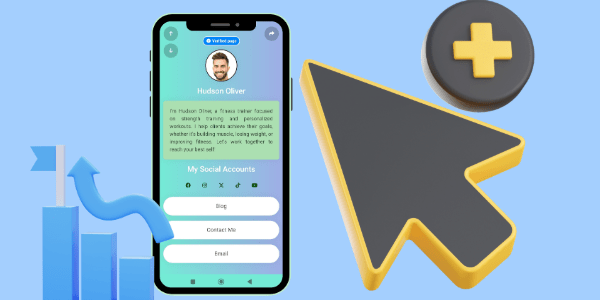
Boost your link-in-bio-clicks with 10 proven strategies used by top creators. Learn how to optimize design, copy, and layout to drive more clicks and conversions.
For years, creators and brands have been chasing one visible metric: follower count. But followers alone do not grow businesses, build email lists, or generate revenue. Link-in-bio clicks do. If people are not clicking, attention is being wasted.
Your link-in-bio is the single bridge between social attention and meaningful action. It is where curiosity either turns into engagement—or disappears. You can have 10,000 followers or 1 million views, but if your link-in-bio clicks are low, your growth is superficial.
As we’ve seen across creator marketing and social commerce, platforms are designed to keep users scrolling, not clicking away. That makes every bio click valuable. When someone taps your link-in-bio, they are raising their hand and saying, “I want more.” That moment deserves to be optimized.
Data consistently supports this shift in thinking. Industry benchmarks show that only a small percentage of profile visitors actually click the bio link, which means even minor improvements can produce outsized gains. Increasing your link-in-bio clicks from 2% to 4% does not sound dramatic—but it can literally double your results without creating new content.
This is why smart creators and businesses focus less on vanity metrics and more on conversion behavior. They treat the bio link as a mini landing page, not a placeholder URL. They align it with content, intent, and timing. And they design it to answer one simple question for the visitor: Why should I click right now?
In this guide, you will learn practical, proven ways to boost your link-in-bio clicks—not through hacks or gimmicks, but by improving clarity, structure, copy, and user experience. These are changes you can apply immediately, regardless of your platform or audience size.
Because at the end of the day, growth does not happen in the feed.
It happens after the click.
2. What Stops People From Clicking Your Link-In-Bio
Before you can fix poor link-in-bio clicks, you have to understand why people aren’t clicking in the first place. Many creators and businesses assume traffic equals engagement, but the reality is more nuanced — and backed by data.
In 2025, well-optimized bio links are converting at 10–20% click-through rates, meaning that for every 100 visitors who view your profile, 10–20 actually click your link-in-bio. Creators who test and refine their value propositions often see rates as high as 25–30%, while poorly optimized profiles can struggle below 8%.Napolify
These numbers highlight a simple truth: most people don’t click because they either don’t understand the value of clicking, or the experience feels confusing or slow.
Common Friction Points
Here are the main reasons link-in-bio clicks lag:
Unclear value proposition
If your page doesn’t answer the question “What’s in it for me?” in seconds, visitors won’t click. Generic or vague CTAs like “More here” or “Click below” don’t communicate benefits.
Too many links — or none at all
Pages with 10+ scattered options create decision fatigue. Users get overwhelmed and bounce, rather than clicking intentionally. Simpler pages with focused links consistently outperform cluttered ones.scn.st
Slow loading or confusing layouts
Mobile users have short attention spans. If your link-in-bio page takes too long to load or looks chaotic on a phone screen, most visitors will leave before engaging.
Mismatch between content and CTA
People come from different contexts — a video, a reel, a story — and expect the link to connect with what they just saw. If your CTA doesn’t deliver on that context, clicks drop.
This pattern mirrors broader trends in digital marketing. As conversion expert Brian Massey once said, “Conversion optimization is not about traffic; it’s about experience.” That experience starts the moment someone looks at your profile and decides whether clicking your link is worth their time.
Understanding these barriers is the first step toward boosting your link-in-bio clicks. In the next section, we’ll cover Way #1 — how to optimize your bio link for a clear, conversion-focused goal so that more visitors don’t just view your profile — they click.
Way #1: Optimize Your Link-in-Bio for One Clear Goal

If there is one principle that has the biggest impact on link-in-bio clicks, it’s focus. As we mentioned earlier, people are less likely to click when they feel unsure. And nothing creates uncertainty faster than a bio link that tries to do everything at once.
When you optimize your link-in-bio for one clear goal, you remove friction and give visitors a reason to act immediately.
One goal beats many options
A common mistake is treating the bio link like a storage page for everything you’ve ever published. Courses, blogs, YouTube videos, affiliate links, and contact pages — all stacked together with equal importance. The result? Visitors hesitate, scroll briefly, and leave.
High-performing creators do the opposite. They decide on one primary action and design the entire link-in-bio around it. Everything else supports that action or stays out of the way.
Examples of clear goals include:
- Growing an email list
- Driving traffic to a product or offer
- Booking calls or demos
- Promoting a specific piece of content
When visitors instantly understand what you want them to do, link-in-bio clicks increase naturally.
Make the main action impossible to miss
Once your goal is defined, your link-in-bio should visually reinforce it. That means:
- The primary link appears first
- It looks different from secondary links
- The copy clearly states the benefit
As we mentioned in Section 1, clicks happen when intent meets clarity. Your top link should feel like the obvious next step, not just another option.
Align your goal with current content
Your bio link does not exist in isolation. It works best when it matches what people just watched, read, or interacted with. If your content promotes a free guide, your link-in-bio should lead directly to that guide. If you’re talking about a product, the link should support that conversation.
This alignment dramatically improves link-in-bio clicks because it meets visitors exactly where they are in their journey.
Marketing strategist Donald Miller summarizes this perfectly:
“If you confuse, you lose.”
By optimizing your link-in-bio around one clear goal, you stop asking visitors to think and start guiding them to act. In the next section, we’ll build on this foundation by showing how structure and layout can further multiply your link-in-bio clicks without changing your audience or content.
Way #2: Use a High-Converting Link-in-Bio Structure

Once your goal is clear, structure becomes the lever that turns attention into action. As we said earlier, people do not read link-in-bio pages — they scan them. A high-converting structure works with that behavior instead of fighting it.
Think of your link-in-bio as a mini landing page, not a list of links. The order, spacing, and visual hierarchy all influence whether someone clicks or leaves.
Lead with context, not links
The first thing visitors should see is not a button — it’s orientation. A short headline or one-line statement that reinforces who you are and why this page matters creates instant clarity.
This context sets expectations and primes users for the desired action. Without it, even strong CTAs feel abrupt or confusing.
Follow a simple visual hierarchy
High-performing link-in-bio pages almost always follow a predictable flow:
- Short headline or positioning statement
- One primary CTA (your main goal)
- Secondary links that support, not compete
- Optional utility links at the bottom
This structure works because it mirrors how landing pages guide attention. As we mentioned earlier, hierarchy reduces decision fatigue — and fewer decisions mean more link-in-bio clicks.
Use spacing to create focus
Whitespace is not wasted space; it’s a conversion tool. Proper spacing between sections and buttons helps users visually separate choices and quickly identify what matters most.
Crowded layouts make visitors slow down or disengage. Clean layouts move them forward.
Keep the page short on purpose
A strong link-in-bio does not scroll forever. Most users decide within seconds whether to click. If they have to scroll repeatedly to understand what to do, you’ve already lost momentum.
As UX expert Steve Krug famously said:
“Don’t make me think.”
A high-converting structure does exactly that — it removes unnecessary thinking.
When your link-in-bio is structured intentionally, you don’t need more traffic to get more results. You simply guide existing attention more effectively. In the next section, we’ll focus on button copy and wording — the small changes that often produce the biggest jumps in link-in-bio clicks.
Way #3: Write Button Copy That Triggers Action

At this point, your structure is doing its job. Now it’s time to focus on the words that sit on top of your buttons — because button copy is often the difference between a glance and a click. As we said earlier, people scan link-in-bio pages quickly. That means every label must communicate value instantly.
Most low-performing link-in-bio pages fail here. Not because the offer is bad, but because the copy is vague.
Replace generic labels with clear benefits
Buttons like “Click here,” “Learn more,” or “My links” don’t tell users what they’ll get. They force visitors to guess — and guessing kills link-in-bio clicks.
High-performing button copy answers one simple question: What happens after I click?
Instead of:
- “Free guide”
- Use:
- “Download the Free Creator Growth Guide”
Instead of:
- “Shop”
- Use:
- “Shop My Best-Selling Tools”
Clear benefits reduce hesitation and increase confidence.
Use action-oriented language
Strong button copy uses verbs that imply movement and outcome. Words like get, start, join, download, and discover subtly nudge users forward.
This is especially effective in a link-in-bio environment, where users are already primed to take small actions. The clearer the action feels, the higher your link-in-bio clicks tend to be.
Keep it short, but not empty
There’s a balance to strike. Button copy should be concise enough to scan, but specific enough to matter. One short line that communicates value will outperform clever or cryptic wording every time.
As copywriting expert Joanna Wiebe puts it:
“Clarity trumps persuasion.”
When your button copy clearly communicates value, persuasion happens naturally.
Match button copy to user intent
As we discussed earlier, visitors arrive from different content contexts. A tutorial video, a product demo, or a personal story all create different expectations. Your button copy should reflect that context to feel relevant.
When the message in your content matches the promise in your link-in-bio, clicks feel like the logical next step — not a leap of faith.
Strong button copy doesn’t need hype. It needs honesty, clarity, and intent. In the next section, we’ll look at why link placement and order alone can dramatically increase your link-in-bio clicks — without changing a single word.
Way #4: Place Your Most Important Link First (Hierarchy Drives Clicks)

Now that your copy is doing its job, the next lever is deceptively simple: position. As we said earlier, people scan link-in-bio pages; they don’t study them. That means the order of your links can have as much impact on link-in-bio clicks as the wording itself.
In practice, most clicks go to the first one or two links on the page. Everything below that sees a sharp drop-off.
The top position gets the attention
Eye-tracking and UX studies consistently show that users focus on what appears first. In a link-in-bio context, this effect is amplified because the page is short and viewed quickly on mobile.
If your most important link is buried halfway down the page, you’re relying on users to scroll, think, and decide. Most won’t.
Instead, your primary link should:
- Appear first on the page
- Be visually distinct from secondary links
- Clearly align with your current goal
As we mentioned earlier, hierarchy removes friction. Position is one of the strongest hierarchy signals you have.
One “hero” link is enough
A common mistake is trying to highlight multiple links equally. Different colors, emojis everywhere, bold text on everything. The result is visual noise.
High-performing link-in-bio pages usually have one hero link and several supporting links that feel intentionally secondary. This makes the decision effortless.
Change order as your priorities change
Your top link should not be permanent. If you launch a new offer, publish a major piece of content, or run a campaign, the order should change to reflect that.
As we said earlier, your link-in-bio is a living asset. Reordering links based on priority is one of the fastest ways to increase link-in-bio clicks without redesigning anything.
Marketing expert Bryan Eisenberg captured this idea well:
“The best marketers don’t guess — they guide.”
By placing your most important link first, you guide attention instead of hoping for it. In the next section, we’ll look at how mobile design and speed directly influence link-in-bio clicks, and why small UX improvements can unlock big gains.
Way #5: Design for Mobile Speed and Thumb-Friendly Taps
By now, your message is clear, your structure is focused, and your top link is in the right place. The next factor that directly affects link-in-bio clicks is something many people underestimate: mobile experience. As we said earlier, nearly all bio link traffic happens on a phone, not a desktop.
If your link-in-bio is even slightly uncomfortable to use on mobile, clicks drop quietly and consistently.
Speed is not a “nice to have”
Mobile users are impatient — and the data confirms it. Google has reported that 53% of mobile users abandon a page if it takes longer than 3 seconds to load. In a link-in-bio context, where attention is already fragile, slow loading kills clicks before your copy even has a chance.
This means:
- Heavy images hurt performance
- Unnecessary animations slow down interaction
- Bloated layouts reduce responsiveness
A fast, lightweight bio link page builds instant trust.
Design for thumbs, not cursors
Link-in-bio pages are tapped, not clicked. Buttons that look fine on desktop often feel cramped on mobile. To improve link-in-bio clicks, your design should prioritize:
- Large, clearly defined buttons
- Enough spacing between links
- High contrast between text and background
If users worry about mis-tapping, they hesitate. Hesitation reduces clicks.
Keep layouts simple and vertical
Complex layouts, multi-column designs, or excessive visual elements work against mobile behavior. A clean vertical flow helps users move naturally from top to bottom without friction.
As we mentioned earlier, your link-in-bio should feel like a mini landing page — and the best mobile landing pages are simple by design.
UX expert Luke Wroblewski summarized this perfectly:
“Mobile forces you to focus.”
When your bio link loads fast, feels comfortable, and respects how people actually use their phones, you remove one of the biggest silent barriers to higher link-in-bio clicks.
In the next section, we’ll explore how aligning your link-in-bio with your content messaging can dramatically increase clicks without changing your design at all.
Way #6: Match Your Link-in-Bio Message With Your Content

At this point, your link-in-bio may be fast, clean, and well-structured — yet clicks can still lag if the message doesn’t match the content that sent people there. As we said earlier, clicks happen when intent meets expectation. When those two are misaligned, users hesitate or bounce.
This is one of the most overlooked reasons link-in-bio clicks stay low.
People click based on momentum
When someone finishes watching a reel, a TikTok, or a story, they are in a specific mindset. They are curious about one thing, not everything. If your bio link presents something unrelated, the momentum breaks.
For example:
- A video about growth strategies should lead to a growth resource
- A product walkthrough should lead to that product page
- A personal story should lead to a deeper relationship step (newsletter, community)
The closer the match, the higher the link-in-bio clicks.
Repeat the promise, don’t change it
A subtle but powerful technique is message mirroring. Use the same language or promise in your content and your bio link.
If your post says, “I shared the exact checklist I use,” your top bio link should echo that wording. This consistency reassures users they’re in the right place and reduces hesitation.
As we mentioned earlier, clarity builds trust — and trust drives clicks.
Use time-based relevance
Your link-in-bio does not need to promote the same thing forever. High-performing creators update their bio link to match what they’re actively posting about right now. This creates a tight loop between content and conversion.
Marketing strategist Andy Crestodina puts it simply:
“Relevance is the currency of the internet.”
When your link-in-bio feels like a natural continuation of your content — not a random destination — clicks feel effortless. In the next section, we’ll explore how visual cues and subtle design signals can quietly direct attention and increase link-in-bio clicks without adding more links.
Way #7: Use Visual Cues to Direct Attention
As we said earlier, people don’t read link-in-bio pages — they react to them. Visual cues are the quiet signals that guide that reaction. When used correctly, they gently nudge visitors toward clicking without feeling pushy or salesy. When ignored, even strong offers can get overlooked.
The key is subtle direction, not distraction.
Highlight what matters most
Your primary link should visually stand out from the rest. This can be done through:
- A slightly stronger color contrast
- A larger button size
- A small icon or emoji used sparingly
The goal is not to decorate, but to create a focal point. As we discussed earlier, hierarchy drives clicks, and visual emphasis reinforces that hierarchy instantly.
Use directional cues sparingly
Arrows, icons, or short labels like “Start here” can significantly improve link-in-bio clicks when used with restraint. These cues act like signposts, especially for new visitors who may not know where to begin.
Too many cues, however, create noise. One clear signal beats five competing ones.
Leverage familiarity and patterns
Users are conditioned by thousands of interfaces. They instinctively recognize buttons, stacked layouts, and centered CTAs. When you align with these familiar patterns, you reduce friction and increase confidence.
As we said earlier, your link-in-bio works best when it feels effortless — not experimental.
Let design support intent, not replace it
Visual cues cannot fix unclear messaging or weak offers. They amplify what already works. When your goal, copy, and structure are aligned, small visual adjustments can unlock meaningful gains in link-in-bio clicks.
Design strategist Don Norman captured this idea well:
“Good design is actually a lot harder to notice than poor design.”
When visual cues quietly guide attention, users don’t feel persuaded — they feel guided. In the next section, we’ll explore why reducing choices often leads to more decisions, and how simplifying your link-in-bio can dramatically increase clicks.
Way #8: Reduce Choices to Increase Decisions

At first glance, it feels logical to add more links. More options should mean more chances to click, right? In reality, the opposite is true. As we said earlier, too many choices create hesitation — and hesitation is the enemy of link-in-bio clicks.
When visitors are faced with multiple equally weighted options, they often pause, scroll briefly, and leave without clicking anything.
Choice overload is real
Behavioral research has repeatedly shown that excessive options reduce action. One of the most cited examples is the “jam study,” where shoppers were far more likely to buy when presented with fewer choices. The same psychology applies to link-in-bio pages.
In a fast-scrolling, mobile-first environment, people don’t want to compare. They want guidance.
Fewer links create clearer intent
High-performing link-in-bio pages usually feature:
- One primary link
- Two or three supporting links at most
Everything else is either removed or temporarily hidden. This approach tells the visitor, “This is what matters right now.”
As we mentioned earlier, your bio link is not an archive — it’s a conversion surface.
Rotate links instead of stacking them
If you have multiple offers, resources, or pieces of content, don’t display them all at once. Rotate them based on relevance, campaigns, or content themes. This keeps your link-in-bio fresh while maintaining focus.
Many creators see link-in-bio clicks increase simply by removing links that no longer serve a clear purpose.
Simplification builds confidence
When users feel confident about what to do next, clicks follow naturally. As product designer Jason Fried once said:
“What you leave out is as important as what you put in.”
Reducing choices doesn’t limit your opportunities — it amplifies the ones that matter most.
In the next section, we’ll focus on tracking link-in-bio clicks and using data to continuously improve performance, so your results keep compounding over time.
Way #9: Track Link-in-Bio Clicks and Optimize With Data

Up to this point, we’ve focused on clarity, structure, copy, and design. Now comes the multiplier: data. As we said earlier, you don’t need more traffic to boost link-in-bio clicks — you need better decisions. And better decisions come from tracking what actually happens after people arrive.
Focus on the metrics that matter
Not every number deserves attention. When optimizing link-in-bio clicks, concentrate on metrics that reflect real intent:
- Total clicks vs. unique visitors
- Click-through rate (CTR) per link
- Performance of your top (hero) link
- Click distribution across positions
These numbers reveal whether your hierarchy and messaging are working — or silently failing.
Let behavior guide placement and copy
A powerful insight many creators discover is that the link they think matters most is not always the one users prefer. Data removes ego from the equation.
If a secondary link consistently outperforms your main CTA, don’t ignore it. Promote it. Rename it. Move it up. As we said earlier, hierarchy is flexible — and should adapt to behavior.
Test small changes, not big redesigns
You don’t need to rebuild your entire link-in-bio to improve results. Small, controlled changes often deliver the biggest gains:
- Changing one button label
- Reordering links
- Highlighting a different primary CTA
Track results, keep what works, and discard what doesn’t. This iterative approach compounds over time.
Review performance regularly
Set a simple habit: review your link-in-bio data weekly or monthly. Look for patterns, not just spikes. Ask:
- Which links are gaining traction?
- Which are being ignored?
- What no longer aligns with current content?
As analytics expert Avinash Kaushik famously said:
“All data in aggregate is crap.”
Meaning: insights come from context, not totals.
When you treat your link-in-bio as a system to refine — not a page to set and forget — link-in-bio clicks become predictable, scalable, and sustainable.
Way #10: Refresh Your Link-in-Bio Regularly to Stay Relevant and Click-Worthy
If there’s one mistake even experienced creators make, it’s treating their link-in-bio as a “set it and forget it” asset. As we said earlier, attention online is dynamic — and your link-in-bio must evolve with it if you want to consistently increase link-in-bio clicks.
Relevance drives clicks more than design
Your audience changes. Your content changes. Your offers change. But many link-in-bio pages remain frozen in time. When visitors see outdated links or promotions that no longer match what they just consumed, trust drops — and clicks disappear.
A fresh link-in-bio signals activity, relevance, and credibility.
Marketing expert Seth Godin put it simply:
“Marketing is no longer about the stuff you make, but the stories you tell.”
Your link-in-bio is part of that story — and outdated stories don’t convert.
Align your link-in-bio with current content
Every time you launch something new — a video, product, newsletter, or campaign — your link-in-bio should reflect it. The strongest link-in-bio clicks happen when there’s a clear continuation from content to action.
For example:
- Posting educational content → highlight a related free resource
- Promoting a product → move it to the top
- Running a limited-time offer → make it visually dominant
This alignment reduces friction and increases intent-based clicks.
Remove clutter and expired links
As we mentioned earlier, fewer links often outperform more links. Periodic cleanup is essential:
- Remove expired offers
- Archive low-performing links
- Merge similar actions
Each removal improves focus — and focus boosts link-in-bio clicks.
Build a simple refresh routine
You don’t need daily updates. A practical cadence works better:
- Weekly for active creators
- Monthly for evergreen brands
- Per campaign for launches
This habit keeps your mini landing page optimized without overthinking.
Final takeaway
Boosting link-in-bio clicks isn’t about hacks — it’s about clarity, relevance, and continuous improvement. When your link-in-bio reflects what your audience wants right now, clicks follow naturally.
At this point, you don’t just have a list of tactics. You have a framework — one you can revisit, refine, and scale as your audience grows.
Final Thoughts: Turning Link-in-Bio Clicks Into Consistent Growth
If you’ve read this far, one thing should be clear: boosting link-in-bio clicks is not about tricks or trendy tools. It’s about intent, clarity, and iteration.
As we said earlier, your link-in-bio is a mini conversion engine. When it’s aligned with your content, focused on one primary action, visually clear, and regularly optimized, clicks stop being random — they become predictable.
Let’s recap the core principle behind all 10 ways:
- Fewer, clearer choices outperform crowded pages
- Strong copy beats clever wording
- Relevance always wins over design alone
- Data should guide decisions, not assumptions
Or, as growth marketer Neil Patel often reminds creators:
“Traffic is great, but conversions are better.”
Your link-in-bio sits exactly at that intersection.
What to do next (practical action)
Don’t try to apply everything at once. Instead:
- Audit your current link-in-bio
- Pick one improvement from this guide
- Implement it
- Measure results
- Repeat
This simple loop is how creators and brands steadily increase link-in-bio clicks over time — without burnout or constant redesigns.